> ## Documentation Index
> Fetch the complete documentation index at: https://restate-6d46e1dc-cloud-docs.mintlify.site/llms.txt
> Use this file to discover all available pages before exploring further.
# Kubernetes
> Learn how to run Restate applications on Kubernetes.
Kubernetes is a common choice for running Restate services in production environments.
This page explains how to deploy Restate applications on Kubernetes with Restate Operator.
The operator lets you:
* [Deploy services on Kubernetes and connect them to Restate Cloud or BYOC](/services/deploy/kubernetes#deploy-a-service-to-restate-cloud-or-byoc)
* [Deploy services on Kubernetes and connect them to a self-hosted Restate environment](/services/deploy/kubernetes#deploy-a-service-to-self-hosted-restate), that can in turn be [managed by the operator](/server/deploy/kubernetes#restate-kubernetes-operator).
## What is the Restate Operator?
The Restate Operator is the recommended way to deploy Restate services on Kubernetes. It manages the Kubernetes workloads for your services and handles registration with Restate and versioning.
The operator extends Kubernetes with resources for running Restate and deploying your service applications:
| Resource | What it manages |
| --------------------------------------------------------------------------------------------------- | ---------------------------------------------------------------------------- |
| [`RestateDeployment`](https://github.com/restatedev/restate-operator#restatedeployment) | Your service workload, Restate registration, and service versioning |
| [`RestateCloudEnvironment`](https://github.com/restatedev/restate-operator#restatecloudenvironment) | The credentials and secure connection to a Restate Cloud or BYOC environment |
| [`RestateCluster`](https://github.com/restatedev/restate-operator#restatecluster) | A self-hosted Restate environment running on Kubernetes |
## What does the operator do for you?
For service deployments, the operator:
* Deploys your application with ReplicaSets or Knative Serving
* Registers its SDK endpoint with Restate Cloud, BYOC, or a self-hosted Restate environment
* Creates a new service revision when your pod template changes
* Keeps old revisions available until their invocations have drained
* Establishes a secure outbound tunnel when connecting private services to Restate Cloud
In ReplicaSet mode, the operator keeps old ReplicaSets and their Service objects available while in-flight invocations drain. In Knative mode, it manages Configurations and Routes for each service version.
[Learn more](/services/versioning#automatic-versioning-with-kubernetes-operator).
Operator 3 introduced Helm-managed CRD upgrades. The first upgrade to version 3 requires a one-time CRD ownership handoff. Follow the [operator 3 upgrade instructions](https://github.com/restatedev/restate-operator/releases/tag/v3.0.0) before upgrading an existing installation.
## Deploy a service to Restate Cloud or BYOC
Restate Cloud must be able to send invocations to your SDK endpoint. For services in a private Kubernetes cluster, you use the Restate Cloud Tunnel to set up a secure connection that does not require exposing a public ingress.
To try this end to end, connect a greeter service on a local kind cluster to Restate Cloud by following this [guide](/guides/connecting-k8s-services-to-cloud).
First, choose a tunnel mode and then follow the corresponding instructions.
### Choose a tunnel mode to connect to Restate Cloud
You can run the tunnel client in your application process or as a standalone deployment:
| | In-process Tunnel | Standalone Tunnel |
| ---------------- | ---------------------------------------------- | ---------------------------------------------------------- |
| Request path | Straight from the service pod to Restate Cloud | Through a standalone tunnel client pod to your service pod |
| Application code | Use the tunnel SDK to serve your services | Keep the normal SDK HTTP listener |
| SDK support | TypeScript and Go (others in-progress) | All SDKs |
| Knative | Not supported | Supported |
We recommend the in-process tunnel client for TypeScript and Go because it removes the extra network hop. Use the standalone tunnel client for other SDKs or when you prefer to operate the client independently from your application.
Each application pod maintains an outbound connection to Restate Cloud. Invocations arrive directly at the SDK handler without a Kubernetes Service or standalone tunnel client pod in the invocation path. The operator injects the environment, region, signing key, and versioned tunnel name through `RESTATE_INPROC_*` environment variables.
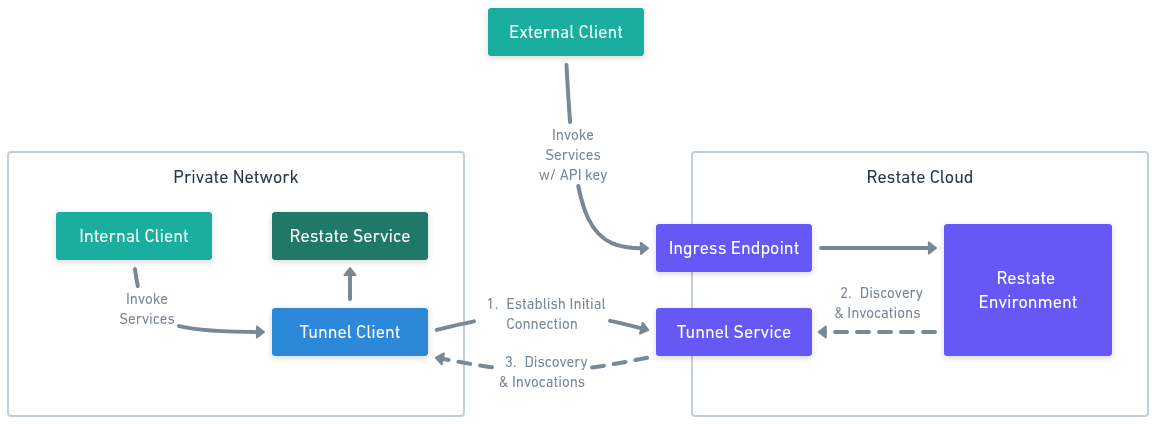
The `RestateCloudEnvironment` runs the tunnel client for you, as a pod in your cluster. It forwards each invocation through a Kubernetes Service to your application pods.
The tunnel client opens an **outbound** connection to Restate Cloud, so your service needs no public ingress and no inbound ports.
1. **Connect.** The tunnel client resolves the tunnel servers for your region and dials out to them, authenticating with your API key. It holds one connection per tunnel server and redials on its own if a connection drops.
2. **Register.** Each connection is keyed by your environment and tunnel name. The deployment URL you register encodes both, plus the address the tunnel client should forward to.
3. **Invoke.** Restate Cloud sends discovery and invocation requests for that deployment to the tunnel server, which streams them down one of the connections registered under that tunnel name.
4. **Forward.** The tunnel client forwards each request to your service's endpoint inside your network, and responses stream back over the same connection.
Requests are signed with your environment's request identity key, so your service only accepts requests that genuinely came from your environment.
Run several tunnel clients with the same tunnel name for redundancy. The tunnel server load balances invocations across every connection registered under that name, so a client going away does not take the deployment offline.
 Both modes use a `RestateCloudEnvironment`. The tunnel mode is selected for each `RestateDeployment`, so services using different modes can share the same Cloud environment resource.
### Deploy a service and connect to Restate Cloud
Choose the tunnel mode you want to use and follow the corresponding instructions:
Use the in-process tunnel client to connect each application pod directly to Restate Cloud without exposing an inbound endpoint. This is the recommended path for TypeScript and Go services.
Install the Restate Operator via Helm:
```bash theme={null}
helm install restate-operator \
oci://ghcr.io/restatedev/restate-operator-helm \
--namespace restate-operator \
--create-namespace
```
To install the operator, you need permission to create namespaces and CRDs.
Create an API key in Restate Cloud at [Developers > API Keys > Create API Key](https://cloud.restate.dev/to/developers/integration?createApiKey=true\&createApiKeyDescription=deployment-key\&createApiKeyRole=rst:role::FullAccess). Save the `key_` value in a file named `token`.
The operator needs the key in the `restate-operator` namespace. The in-process tunnel client needs the same key in your service's namespace because Kubernetes Secrets are namespace scoped:
```bash theme={null}
kubectl create secret generic my-cloud-environment-secret \
--from-file=token=./token -n restate-operator
kubectl create secret generic restate-cloud-tunnel-auth \
--from-file=token=./token -n your-service-namespace
```
Create the environment manifest:
```yaml restate-cloud-environment.yaml theme={null}
apiVersion: restate.dev/v1beta1
kind: RestateCloudEnvironment
metadata:
name: my-cloud-environment
spec:
environmentId: env_...
signingPublicKey: publickeyv1_...
region: eu
authentication:
secret:
name: my-cloud-environment-secret
key: token
```
* `environmentId`: copy it from the top left corner of the Restate Cloud UI. It starts with `env_`.
* `signingPublicKey`: copy it from [**Developers > Security > HTTP endpoints**](https://cloud.restate.dev/to/developers/integration#http-endpoints). It starts with `publickeyv1_`.
* `region`: use the identifier shown next to your environment ID, such as `us` or `eu`. BYOC environments can use a multi-label identifier such as `.byoc`.
```bash theme={null}
kubectl apply -f restate-cloud-environment.yaml
```
For all available options, see the `RestateCloudEnvironment` specification as [Pkl](https://github.com/restatedev/restate-operator/blob/main/crd/RestateCloudEnvironment.pkl) (recommended) or [YAML](https://github.com/restatedev/restate-operator/blob/main/crd/restatecloudenvironments.yaml).
A `RestateCloudEnvironment` deploys a standalone tunnel client pod by default. Services configured with `tunnelMode: in-process` connect directly from their application pods and do not use that pod in their invocation path.
Replace the normal SDK listener with the in-process tunnel client:
```bash TypeScript theme={null}
npm install @restatedev/restate-sdk-tunnel
```
```bash Go theme={null}
go get github.com/restatedev/sdk-go/x/tunnel
```
```typescript TypeScript {"CODE_LOAD::ts/src/develop/tunnel-operator.ts#operator_in_process_tunnel"} theme={null}
import { connectTunnel } from "@restatedev/restate-sdk-tunnel";
import { greeter } from "./greeter";
connectTunnel({ services: [greeter] });
```
```go Go {"CODE_LOAD::go/develop/tunnel_operator.go#operator_in_process_tunnel"} theme={null}
import (
"context"
"log/slog"
"os"
"os/signal"
"syscall"
restate "github.com/restatedev/sdk-go"
"github.com/restatedev/sdk-go/server"
"github.com/restatedev/sdk-go/x/tunnel"
)
func serve() {
ctx, stop := signal.NotifyContext(context.Background(), syscall.SIGINT, syscall.SIGTERM)
defer stop()
srv := server.NewRestate().
Bind(restate.Reflect(MyService{}))
// The Restate Operator injects the env vars for connecting to Cloud
// Start blocks until ctx is cancelled (SIGINT/SIGTERM), then drains and closes.
err := tunnel.NewTunnel(srv).Start(ctx)
if err != nil {
slog.Error("tunnel exited with error", "err", err.Error())
os.Exit(1)
}
}
```
In TypeScript, `connectTunnel(...)` replaces `restate.serve(...)`. In Go, `tunnel.NewTunnel(srv).Start(...)` replaces `srv.Start(...)`.
In-process tunnel clients for the other Restate SDKs are coming. Check the SDK release notes for updates.
The in-process tunnel client is not supported with Knative mode.
Create a [`RestateDeployment`](https://github.com/restatedev/restate-operator#restatedeployment) with `tunnelMode: in-process` and mount the API key Secret:
```yaml expandable service-deployment.yaml theme={null}
apiVersion: restate.dev/v1beta1
kind: RestateDeployment
metadata:
name: service
spec:
replicas: 1
restate:
register:
cloud: my-cloud-environment
tunnelMode: in-process
selector:
matchLabels:
app: service
template:
metadata:
labels:
app: service
spec:
containers:
- name: service
image: path.to/yourrepo:yourtag
env:
- name: RESTATE_INPROC_AUTH_TOKEN_FILE
value: /var/run/secrets/restate.cloud/token
volumeMounts:
- name: restate-cloud-tunnel-auth
mountPath: /var/run/secrets/restate.cloud
readOnly: true
volumes:
- name: restate-cloud-tunnel-auth
secret:
secretName: restate-cloud-tunnel-auth
```
```bash theme={null}
kubectl apply -f service-deployment.yaml -n your-service-namespace
```
The operator injects the remaining `RESTATE_INPROC_*` configuration, registers the tunnel URL, and handles [versioning](/services/versioning#automatic-versioning-with-kubernetes-operator).
Go to the Restate Cloud UI's Playground and send a request to your service.
Use the standalone tunnel client managed by the `RestateCloudEnvironment`. Your application keeps its normal HTTP listener, and the tunnel client pod forwards Restate Cloud invocations to its Kubernetes Service.
Install the Restate Operator via Helm:
```bash theme={null}
helm install restate-operator \
oci://ghcr.io/restatedev/restate-operator-helm \
--namespace restate-operator \
--create-namespace
```
To install the operator, you need permission to create namespaces and CRDs.
Create an API key in Restate Cloud at [Developers > API Keys > Create API Key](https://cloud.restate.dev/to/developers/integration?createApiKey=true\&createApiKeyDescription=deployment-key\&createApiKeyRole=rst:role::FullAccess). Save the `key_` value in a file named `token`, then create the Secret in the operator namespace:
```bash theme={null}
kubectl create secret generic my-cloud-environment-secret \
--from-file=token=./token -n restate-operator
```
Create the environment manifest. This resource deploys the standalone tunnel client pod used by this path:
```yaml restate-cloud-environment.yaml theme={null}
apiVersion: restate.dev/v1beta1
kind: RestateCloudEnvironment
metadata:
name: my-cloud-environment
spec:
environmentId: env_...
signingPublicKey: publickeyv1_...
region: eu
authentication:
secret:
name: my-cloud-environment-secret
key: token
```
* `environmentId`: copy it from the top left corner of the Restate Cloud UI. It starts with `env_`.
* `signingPublicKey`: copy it from [**Developers > Security > HTTP endpoints**](https://cloud.restate.dev/to/developers/integration#http-endpoints). It starts with `publickeyv1_`.
* `region`: use the identifier shown next to your environment ID, such as `us` or `eu`. BYOC environments can use a multi-label identifier such as `.byoc`.
```bash theme={null}
kubectl apply -f restate-cloud-environment.yaml
```
For all available options, see the `RestateCloudEnvironment` specification as [Pkl](https://github.com/restatedev/restate-operator/blob/main/crd/RestateCloudEnvironment.pkl) (recommended) or [YAML](https://github.com/restatedev/restate-operator/blob/main/crd/restatecloudenvironments.yaml).
Create a [`RestateDeployment`](https://github.com/restatedev/restate-operator#restatedeployment) with `tunnelMode: external`:
```yaml expandable service-deployment.yaml theme={null}
apiVersion: restate.dev/v1beta1
kind: RestateDeployment
metadata:
name: service
spec:
replicas: 1
restate:
register:
cloud: my-cloud-environment
tunnelMode: external
selector:
matchLabels:
app: service
template:
metadata:
labels:
app: service
spec:
containers:
- name: service
image: path.to/yourrepo:yourtag
env:
- name: PORT
value: "9080"
ports:
- containerPort: 9080
name: restate
```
```bash theme={null}
kubectl apply -f service-deployment.yaml -n your-service-namespace
```
The operator creates a Kubernetes Service for the SDK endpoint, registers it through the standalone tunnel client, and handles [versioning](/services/versioning#automatic-versioning-with-kubernetes-operator).
Go to the Restate Cloud UI's Playground and send a request to your service.
## Deploy a service to self-hosted Restate
Register your service with a self-hosted Restate environment. This example uses a `RestateCluster` resource named `restate` in the same Kubernetes cluster, so no Restate Cloud tunnel or Cloud API key is required.
To deploy a self-hosted Restate cluster with the operator, see [Deploy Restate on Kubernetes](/server/deploy/kubernetes). To try the complete setup on a local kind cluster, follow the [operator guide](/guides/restate-on-kind-with-operator).
Install the Restate Operator via Helm:
```bash theme={null}
helm install restate-operator \
oci://ghcr.io/restatedev/restate-operator-helm \
--namespace restate-operator \
--create-namespace
```
To install the operator, you need permission to create namespaces and CRDs.
Create a `RestateDeployment` that references [your `RestateCluster` named `restate`](/server/deploy/kubernetes#restate-kubernetes-operator):
```yaml service-deployment.yaml theme={null}
apiVersion: restate.dev/v1beta1
kind: RestateDeployment
metadata:
name: service
spec:
replicas: 1
restate:
register:
cluster: restate
selector:
matchLabels:
app: service
template:
metadata:
labels:
app: service
spec:
containers:
- name: service
image: path.to/yourrepo:yourtag
env:
- name: PORT
value: "9080"
ports:
- containerPort: 9080
name: restate
```
```bash theme={null}
kubectl apply -f service-deployment.yaml -n your-service-namespace
```
Once applied, the Restate Operator registers your service and handles [versioning](/services/versioning#automatic-versioning-with-kubernetes-operator).
Read the [`RestateDeployment` documentation](https://github.com/restatedev/restate-operator#restatedeployment), or view the full specification as [Pkl](https://github.com/restatedev/restate-operator/blob/main/crd/RestateDeployment.pkl) or [YAML](https://github.com/restatedev/restate-operator/blob/main/crd/restatedeployments.yaml).
Go to the Restate UI's Playground and send a request to your service.
## Knative Deployment
The `RestateDeployment` CRD can use Knative Serving instead of ReplicaSets. The operator then manages the Knative Configurations, Routes, Restate registration, and service versions while Knative provides request-based autoscaling and scale-to-zero.
Install [Knative Serving](https://knative.dev/docs/install/) before applying a Knative-mode `RestateDeployment`:
```yaml theme={null}
apiVersion: restate.dev/v1beta1
kind: RestateDeployment
metadata:
name: service
spec:
deploymentMode: knative
knative:
tag: v1
minScale: 0
maxScale: 10
target: 50
restate:
register:
cluster: restate
template:
metadata:
labels:
app: service
spec:
containers:
- name: service
image: path.to/yourrepo:yourtag
ports:
- name: h2c
containerPort: 9080
```
The example registers with a `RestateCluster` named `restate`. To register with Restate Cloud or BYOC, use `cloud: my-cloud-environment` instead.
The optional `knative.tag` controls deployment identity:
* Keep the same tag for an in-place update to the existing Restate deployment. Only do this when the change is compatible with invocations already assigned to that deployment.
* Change the tag to create and register a new version while the previous version drains.
* Omit the tag to use the pod template hash and create a new version for every template change.
The container port must be named `h2c` for HTTP/2 or `http1` for HTTP/1.1. In-process Restate Cloud tunnels are not supported in Knative mode.
See the operator's [Knative Serving documentation](https://github.com/restatedev/restate-operator#knative-serving-mode) and [complete examples](https://github.com/restatedev/restate-operator/tree/main/examples/services/greeter/k8s).
To run on Knative without the operator, see the accordion under [Direct Kubernetes deployments](#direct-kubernetes-deployments).
## Horizontal scaling and load balancing
Restate allows scaling your services horizontally by running multiple replicas of your pods.
To distribute traffic across these pods, you need to set up load balancing in between the Restate server and your service pods.
This way, Restate gets a stable endpoint to send requests to, and the load balancer distributes the requests across the available pods.
#### Autoscale operator-managed revisions
In ReplicaSet mode, you can attach your own HorizontalPodAutoscaler to the `RestateDeployment` scale subresource to scale the latest revision. You can also configure `spec.autoscaling` so the operator creates an HPA for each older revision while its invocations drain:
```yaml theme={null}
spec:
replicas: 3
autoscaling:
minReplicas: 1
maxReplicas: 10
metrics:
- type: Resource
resource:
name: cpu
target:
type: Utilization
averageUtilization: 70
```
The operator supplies the HPA's `scaleTargetRef`. CPU and memory metrics require resource requests on your service containers. This setting applies only to draining revisions in ReplicaSet mode. Knative uses its own autoscaler.
In a standard Kubernetes setup, you would typically use a `Service` of type `ClusterIP` or `LoadBalancer` to distribute traffic across your pods.
Kubernetes Services distribute new connections across eligible pods. The exact behavior depends on your cluster's networking implementation.
If your services are running over HTTP/2 (the default), each Restate partition will generally have only one TCP connection to a single destination pod.
However, because there are many partitions (by default 24, typically more in a larger cluster) this should get your pods a reasonably
even distribution of traffic.
For more advanced load balancing options, you can use an L7 load balancer like Istio or Cilium.
Note that there is no need for routing to be sticky, because each invocation is self-contained and has all the context it needs to execute (the journal and any K/V state).
No context is assumed to be sticky on the node.
However, if you wish to do so, you can do sticky routing via the invocation ID in your request headers (`x-restate-invocation-id`).
## Direct Kubernetes deployments
Use the Restate Operator when you want automatic registration, version management, and operator-managed scaling.
If you prefer not to use the Restate Operator, you can deploy your Restate services directly using standard Kubernetes `Deployment` and `Service` resources.
A Kubernetes `Deployment` of more than one replica is generally appropriate,
and a Kubernetes `Service` is used to provide a stable DNS name and IP for the pods.
Here is an example manifest with a single pod in Kubernetes:
```yaml expandable theme={null}
apiVersion: apps/v1
kind: Deployment
metadata:
name: service
spec:
replicas: 1
selector:
matchLabels:
app: service
template:
metadata:
labels:
app: service
spec:
containers:
- name: service
image: path.to/yourrepo:yourtag
env:
- name: PORT
value: "9080"
ports:
- containerPort: 9080
name: restate
---
apiVersion: v1
kind: Service
metadata:
name: service
spec:
selector:
app: service
ports:
- port: 9080
name: restate
type: ClusterIP
```
Once you have applied the manifest, [register the service](/services/versioning#registering-a-deployment) at `http://.:9080`.
⚠️ Note that this setup will not account for keeping around old code versions, so updating your code can break in-flight invocations.
Check the [versioning documentation](/services/versioning) for more information.
Restate services also run on a plain Knative `Service`, without the operator. There are no special container requirements beyond naming the port `h2c`:
```shell theme={null}
kn service create service-name --port h2c:9080 --image path.to/yourrepo:yourtag
```
Or as a manifest:
```yaml theme={null}
apiVersion: serving.knative.dev/v1
kind: Service
metadata:
name: service-name
spec:
template:
spec:
containers:
- image: path.to/yourrepo:yourtag
ports:
- name: h2c
containerPort: 9080
```
The service is reachable at `http://.`, but to handle [versioning](/services/versioning) it is preferable to register the revision URL, such as `http://-0001.`, as part of your deployment workflow.
Knative exposes the service through the Ingress by default. Restate does not require this, so you can pass `--cluster-local` to the creation command to disable it.
Learn more in this [blog post](https://www.restate.dev/blog/building-stateful-serverless-applications-with-knative-and-restate) and the [Go example](https://github.com/restatedev/examples/tree/main/go/integrations/knative-go).
Both modes use a `RestateCloudEnvironment`. The tunnel mode is selected for each `RestateDeployment`, so services using different modes can share the same Cloud environment resource.
### Deploy a service and connect to Restate Cloud
Choose the tunnel mode you want to use and follow the corresponding instructions:
Use the in-process tunnel client to connect each application pod directly to Restate Cloud without exposing an inbound endpoint. This is the recommended path for TypeScript and Go services.
Install the Restate Operator via Helm:
```bash theme={null}
helm install restate-operator \
oci://ghcr.io/restatedev/restate-operator-helm \
--namespace restate-operator \
--create-namespace
```
To install the operator, you need permission to create namespaces and CRDs.
Create an API key in Restate Cloud at [Developers > API Keys > Create API Key](https://cloud.restate.dev/to/developers/integration?createApiKey=true\&createApiKeyDescription=deployment-key\&createApiKeyRole=rst:role::FullAccess). Save the `key_` value in a file named `token`.
The operator needs the key in the `restate-operator` namespace. The in-process tunnel client needs the same key in your service's namespace because Kubernetes Secrets are namespace scoped:
```bash theme={null}
kubectl create secret generic my-cloud-environment-secret \
--from-file=token=./token -n restate-operator
kubectl create secret generic restate-cloud-tunnel-auth \
--from-file=token=./token -n your-service-namespace
```
Create the environment manifest:
```yaml restate-cloud-environment.yaml theme={null}
apiVersion: restate.dev/v1beta1
kind: RestateCloudEnvironment
metadata:
name: my-cloud-environment
spec:
environmentId: env_...
signingPublicKey: publickeyv1_...
region: eu
authentication:
secret:
name: my-cloud-environment-secret
key: token
```
* `environmentId`: copy it from the top left corner of the Restate Cloud UI. It starts with `env_`.
* `signingPublicKey`: copy it from [**Developers > Security > HTTP endpoints**](https://cloud.restate.dev/to/developers/integration#http-endpoints). It starts with `publickeyv1_`.
* `region`: use the identifier shown next to your environment ID, such as `us` or `eu`. BYOC environments can use a multi-label identifier such as `.byoc`.
```bash theme={null}
kubectl apply -f restate-cloud-environment.yaml
```
For all available options, see the `RestateCloudEnvironment` specification as [Pkl](https://github.com/restatedev/restate-operator/blob/main/crd/RestateCloudEnvironment.pkl) (recommended) or [YAML](https://github.com/restatedev/restate-operator/blob/main/crd/restatecloudenvironments.yaml).
A `RestateCloudEnvironment` deploys a standalone tunnel client pod by default. Services configured with `tunnelMode: in-process` connect directly from their application pods and do not use that pod in their invocation path.
Replace the normal SDK listener with the in-process tunnel client:
```bash TypeScript theme={null}
npm install @restatedev/restate-sdk-tunnel
```
```bash Go theme={null}
go get github.com/restatedev/sdk-go/x/tunnel
```
```typescript TypeScript {"CODE_LOAD::ts/src/develop/tunnel-operator.ts#operator_in_process_tunnel"} theme={null}
import { connectTunnel } from "@restatedev/restate-sdk-tunnel";
import { greeter } from "./greeter";
connectTunnel({ services: [greeter] });
```
```go Go {"CODE_LOAD::go/develop/tunnel_operator.go#operator_in_process_tunnel"} theme={null}
import (
"context"
"log/slog"
"os"
"os/signal"
"syscall"
restate "github.com/restatedev/sdk-go"
"github.com/restatedev/sdk-go/server"
"github.com/restatedev/sdk-go/x/tunnel"
)
func serve() {
ctx, stop := signal.NotifyContext(context.Background(), syscall.SIGINT, syscall.SIGTERM)
defer stop()
srv := server.NewRestate().
Bind(restate.Reflect(MyService{}))
// The Restate Operator injects the env vars for connecting to Cloud
// Start blocks until ctx is cancelled (SIGINT/SIGTERM), then drains and closes.
err := tunnel.NewTunnel(srv).Start(ctx)
if err != nil {
slog.Error("tunnel exited with error", "err", err.Error())
os.Exit(1)
}
}
```
In TypeScript, `connectTunnel(...)` replaces `restate.serve(...)`. In Go, `tunnel.NewTunnel(srv).Start(...)` replaces `srv.Start(...)`.
In-process tunnel clients for the other Restate SDKs are coming. Check the SDK release notes for updates.
The in-process tunnel client is not supported with Knative mode.
Create a [`RestateDeployment`](https://github.com/restatedev/restate-operator#restatedeployment) with `tunnelMode: in-process` and mount the API key Secret:
```yaml expandable service-deployment.yaml theme={null}
apiVersion: restate.dev/v1beta1
kind: RestateDeployment
metadata:
name: service
spec:
replicas: 1
restate:
register:
cloud: my-cloud-environment
tunnelMode: in-process
selector:
matchLabels:
app: service
template:
metadata:
labels:
app: service
spec:
containers:
- name: service
image: path.to/yourrepo:yourtag
env:
- name: RESTATE_INPROC_AUTH_TOKEN_FILE
value: /var/run/secrets/restate.cloud/token
volumeMounts:
- name: restate-cloud-tunnel-auth
mountPath: /var/run/secrets/restate.cloud
readOnly: true
volumes:
- name: restate-cloud-tunnel-auth
secret:
secretName: restate-cloud-tunnel-auth
```
```bash theme={null}
kubectl apply -f service-deployment.yaml -n your-service-namespace
```
The operator injects the remaining `RESTATE_INPROC_*` configuration, registers the tunnel URL, and handles [versioning](/services/versioning#automatic-versioning-with-kubernetes-operator).
Go to the Restate Cloud UI's Playground and send a request to your service.
Use the standalone tunnel client managed by the `RestateCloudEnvironment`. Your application keeps its normal HTTP listener, and the tunnel client pod forwards Restate Cloud invocations to its Kubernetes Service.
Install the Restate Operator via Helm:
```bash theme={null}
helm install restate-operator \
oci://ghcr.io/restatedev/restate-operator-helm \
--namespace restate-operator \
--create-namespace
```
To install the operator, you need permission to create namespaces and CRDs.
Create an API key in Restate Cloud at [Developers > API Keys > Create API Key](https://cloud.restate.dev/to/developers/integration?createApiKey=true\&createApiKeyDescription=deployment-key\&createApiKeyRole=rst:role::FullAccess). Save the `key_` value in a file named `token`, then create the Secret in the operator namespace:
```bash theme={null}
kubectl create secret generic my-cloud-environment-secret \
--from-file=token=./token -n restate-operator
```
Create the environment manifest. This resource deploys the standalone tunnel client pod used by this path:
```yaml restate-cloud-environment.yaml theme={null}
apiVersion: restate.dev/v1beta1
kind: RestateCloudEnvironment
metadata:
name: my-cloud-environment
spec:
environmentId: env_...
signingPublicKey: publickeyv1_...
region: eu
authentication:
secret:
name: my-cloud-environment-secret
key: token
```
* `environmentId`: copy it from the top left corner of the Restate Cloud UI. It starts with `env_`.
* `signingPublicKey`: copy it from [**Developers > Security > HTTP endpoints**](https://cloud.restate.dev/to/developers/integration#http-endpoints). It starts with `publickeyv1_`.
* `region`: use the identifier shown next to your environment ID, such as `us` or `eu`. BYOC environments can use a multi-label identifier such as `.byoc`.
```bash theme={null}
kubectl apply -f restate-cloud-environment.yaml
```
For all available options, see the `RestateCloudEnvironment` specification as [Pkl](https://github.com/restatedev/restate-operator/blob/main/crd/RestateCloudEnvironment.pkl) (recommended) or [YAML](https://github.com/restatedev/restate-operator/blob/main/crd/restatecloudenvironments.yaml).
Create a [`RestateDeployment`](https://github.com/restatedev/restate-operator#restatedeployment) with `tunnelMode: external`:
```yaml expandable service-deployment.yaml theme={null}
apiVersion: restate.dev/v1beta1
kind: RestateDeployment
metadata:
name: service
spec:
replicas: 1
restate:
register:
cloud: my-cloud-environment
tunnelMode: external
selector:
matchLabels:
app: service
template:
metadata:
labels:
app: service
spec:
containers:
- name: service
image: path.to/yourrepo:yourtag
env:
- name: PORT
value: "9080"
ports:
- containerPort: 9080
name: restate
```
```bash theme={null}
kubectl apply -f service-deployment.yaml -n your-service-namespace
```
The operator creates a Kubernetes Service for the SDK endpoint, registers it through the standalone tunnel client, and handles [versioning](/services/versioning#automatic-versioning-with-kubernetes-operator).
Go to the Restate Cloud UI's Playground and send a request to your service.
## Deploy a service to self-hosted Restate
Register your service with a self-hosted Restate environment. This example uses a `RestateCluster` resource named `restate` in the same Kubernetes cluster, so no Restate Cloud tunnel or Cloud API key is required.
To deploy a self-hosted Restate cluster with the operator, see [Deploy Restate on Kubernetes](/server/deploy/kubernetes). To try the complete setup on a local kind cluster, follow the [operator guide](/guides/restate-on-kind-with-operator).
Install the Restate Operator via Helm:
```bash theme={null}
helm install restate-operator \
oci://ghcr.io/restatedev/restate-operator-helm \
--namespace restate-operator \
--create-namespace
```
To install the operator, you need permission to create namespaces and CRDs.
Create a `RestateDeployment` that references [your `RestateCluster` named `restate`](/server/deploy/kubernetes#restate-kubernetes-operator):
```yaml service-deployment.yaml theme={null}
apiVersion: restate.dev/v1beta1
kind: RestateDeployment
metadata:
name: service
spec:
replicas: 1
restate:
register:
cluster: restate
selector:
matchLabels:
app: service
template:
metadata:
labels:
app: service
spec:
containers:
- name: service
image: path.to/yourrepo:yourtag
env:
- name: PORT
value: "9080"
ports:
- containerPort: 9080
name: restate
```
```bash theme={null}
kubectl apply -f service-deployment.yaml -n your-service-namespace
```
Once applied, the Restate Operator registers your service and handles [versioning](/services/versioning#automatic-versioning-with-kubernetes-operator).
Read the [`RestateDeployment` documentation](https://github.com/restatedev/restate-operator#restatedeployment), or view the full specification as [Pkl](https://github.com/restatedev/restate-operator/blob/main/crd/RestateDeployment.pkl) or [YAML](https://github.com/restatedev/restate-operator/blob/main/crd/restatedeployments.yaml).
Go to the Restate UI's Playground and send a request to your service.
## Knative Deployment
The `RestateDeployment` CRD can use Knative Serving instead of ReplicaSets. The operator then manages the Knative Configurations, Routes, Restate registration, and service versions while Knative provides request-based autoscaling and scale-to-zero.
Install [Knative Serving](https://knative.dev/docs/install/) before applying a Knative-mode `RestateDeployment`:
```yaml theme={null}
apiVersion: restate.dev/v1beta1
kind: RestateDeployment
metadata:
name: service
spec:
deploymentMode: knative
knative:
tag: v1
minScale: 0
maxScale: 10
target: 50
restate:
register:
cluster: restate
template:
metadata:
labels:
app: service
spec:
containers:
- name: service
image: path.to/yourrepo:yourtag
ports:
- name: h2c
containerPort: 9080
```
The example registers with a `RestateCluster` named `restate`. To register with Restate Cloud or BYOC, use `cloud: my-cloud-environment` instead.
The optional `knative.tag` controls deployment identity:
* Keep the same tag for an in-place update to the existing Restate deployment. Only do this when the change is compatible with invocations already assigned to that deployment.
* Change the tag to create and register a new version while the previous version drains.
* Omit the tag to use the pod template hash and create a new version for every template change.
The container port must be named `h2c` for HTTP/2 or `http1` for HTTP/1.1. In-process Restate Cloud tunnels are not supported in Knative mode.
See the operator's [Knative Serving documentation](https://github.com/restatedev/restate-operator#knative-serving-mode) and [complete examples](https://github.com/restatedev/restate-operator/tree/main/examples/services/greeter/k8s).
To run on Knative without the operator, see the accordion under [Direct Kubernetes deployments](#direct-kubernetes-deployments).
## Horizontal scaling and load balancing
Restate allows scaling your services horizontally by running multiple replicas of your pods.
To distribute traffic across these pods, you need to set up load balancing in between the Restate server and your service pods.
This way, Restate gets a stable endpoint to send requests to, and the load balancer distributes the requests across the available pods.
#### Autoscale operator-managed revisions
In ReplicaSet mode, you can attach your own HorizontalPodAutoscaler to the `RestateDeployment` scale subresource to scale the latest revision. You can also configure `spec.autoscaling` so the operator creates an HPA for each older revision while its invocations drain:
```yaml theme={null}
spec:
replicas: 3
autoscaling:
minReplicas: 1
maxReplicas: 10
metrics:
- type: Resource
resource:
name: cpu
target:
type: Utilization
averageUtilization: 70
```
The operator supplies the HPA's `scaleTargetRef`. CPU and memory metrics require resource requests on your service containers. This setting applies only to draining revisions in ReplicaSet mode. Knative uses its own autoscaler.
In a standard Kubernetes setup, you would typically use a `Service` of type `ClusterIP` or `LoadBalancer` to distribute traffic across your pods.
Kubernetes Services distribute new connections across eligible pods. The exact behavior depends on your cluster's networking implementation.
If your services are running over HTTP/2 (the default), each Restate partition will generally have only one TCP connection to a single destination pod.
However, because there are many partitions (by default 24, typically more in a larger cluster) this should get your pods a reasonably
even distribution of traffic.
For more advanced load balancing options, you can use an L7 load balancer like Istio or Cilium.
Note that there is no need for routing to be sticky, because each invocation is self-contained and has all the context it needs to execute (the journal and any K/V state).
No context is assumed to be sticky on the node.
However, if you wish to do so, you can do sticky routing via the invocation ID in your request headers (`x-restate-invocation-id`).
## Direct Kubernetes deployments
Use the Restate Operator when you want automatic registration, version management, and operator-managed scaling.
If you prefer not to use the Restate Operator, you can deploy your Restate services directly using standard Kubernetes `Deployment` and `Service` resources.
A Kubernetes `Deployment` of more than one replica is generally appropriate,
and a Kubernetes `Service` is used to provide a stable DNS name and IP for the pods.
Here is an example manifest with a single pod in Kubernetes:
```yaml expandable theme={null}
apiVersion: apps/v1
kind: Deployment
metadata:
name: service
spec:
replicas: 1
selector:
matchLabels:
app: service
template:
metadata:
labels:
app: service
spec:
containers:
- name: service
image: path.to/yourrepo:yourtag
env:
- name: PORT
value: "9080"
ports:
- containerPort: 9080
name: restate
---
apiVersion: v1
kind: Service
metadata:
name: service
spec:
selector:
app: service
ports:
- port: 9080
name: restate
type: ClusterIP
```
Once you have applied the manifest, [register the service](/services/versioning#registering-a-deployment) at `http://.:9080`.
⚠️ Note that this setup will not account for keeping around old code versions, so updating your code can break in-flight invocations.
Check the [versioning documentation](/services/versioning) for more information.
Restate services also run on a plain Knative `Service`, without the operator. There are no special container requirements beyond naming the port `h2c`:
```shell theme={null}
kn service create service-name --port h2c:9080 --image path.to/yourrepo:yourtag
```
Or as a manifest:
```yaml theme={null}
apiVersion: serving.knative.dev/v1
kind: Service
metadata:
name: service-name
spec:
template:
spec:
containers:
- image: path.to/yourrepo:yourtag
ports:
- name: h2c
containerPort: 9080
```
The service is reachable at `http://.`, but to handle [versioning](/services/versioning) it is preferable to register the revision URL, such as `http://-0001.`, as part of your deployment workflow.
Knative exposes the service through the Ingress by default. Restate does not require this, so you can pass `--cluster-local` to the creation command to disable it.
Learn more in this [blog post](https://www.restate.dev/blog/building-stateful-serverless-applications-with-knative-and-restate) and the [Go example](https://github.com/restatedev/examples/tree/main/go/integrations/knative-go).